Patient Retention Strategies for Chiropractors: Keep More Plans, Lose the Gaps
Progress, reminders, and a 6-month nurture that finishes plans.
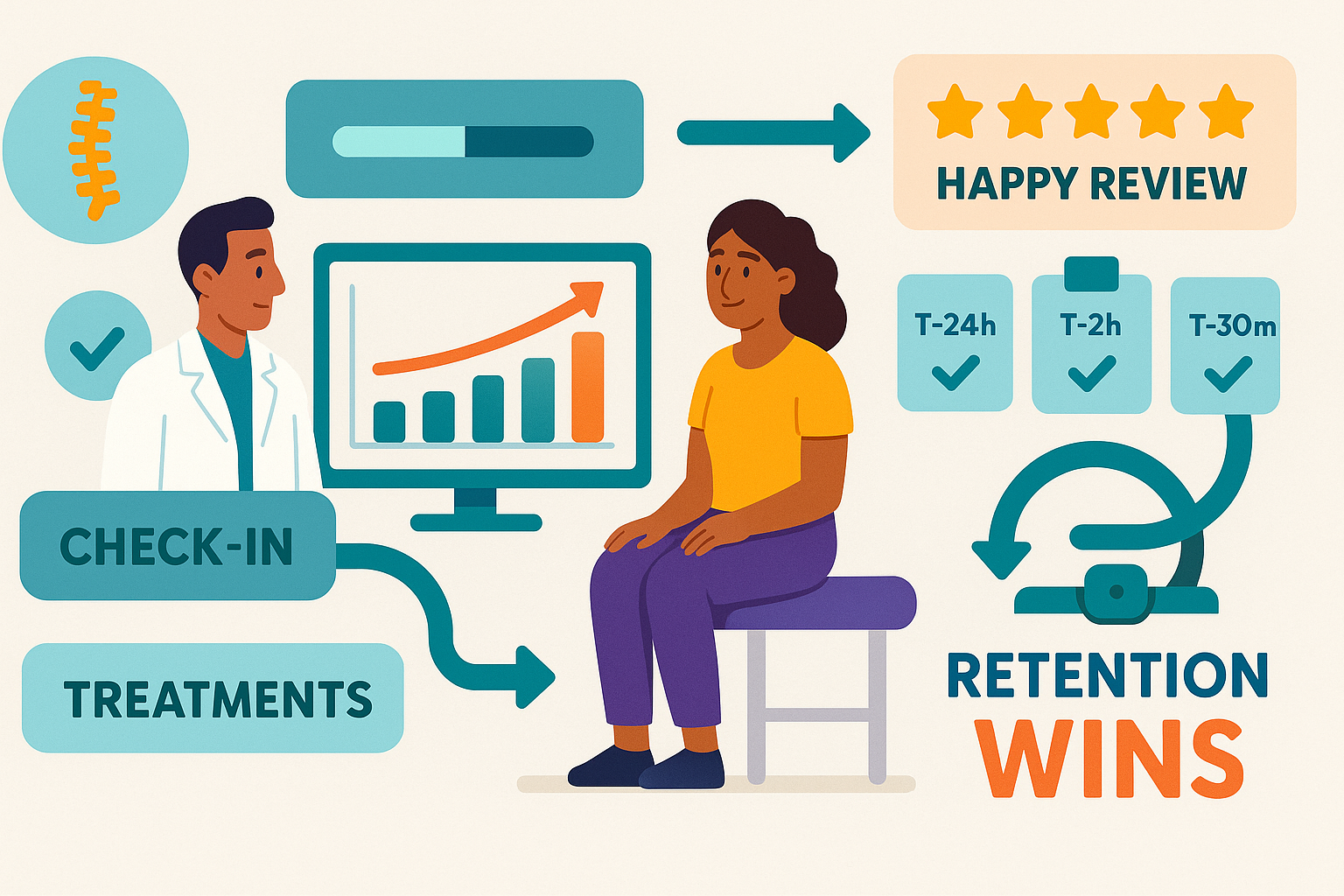
Patient Retention Strategies for Chiropractors: Keep More Plans, Lose the Gaps
TL;DR: Patients don’t quit because of price-they quit when progress isn’t visible and logistics are messy. Fix retention with three pillars: (1) progress visibility, (2) reminder + rescue cadence, (3) a simple 6-month nurture. Use the copy-paste scripts below, track five KPIs weekly, and expect higher show rates, fewer mid-plan drop-offs, more reviews/referrals, and steadier collections.
Why retention matters (quick math)
If you run one seminar/month and convert 12 patients into $4,500 plans, then:
- Raising plan completion from 60% → 80% adds 2–3 finished plans/month.
- At ~$4,050 net/plan (after $399 credit + 10% window), that’s $8,100–$12,150 extra monthly without buying more leads.
Retention is your lowest-cost revenue lever.
New here? See the whole engine: /how-it-works
Diagnose your bottlenecks: Scheduling → /analyzer • Cash Flow → /cash-flow-analyzer
Step 0 - Baseline your five retention KPIs (15 minutes)
Write these on a whiteboard for the last 30 days:
- Show Rate = kept appts ÷ scheduled appts - Target: ≥ 70%
- Mid-Plan Drop-Off = stopped before plan end ÷ plan starts - Target: ≤ 20%
- Plan Completion = finished plans ÷ plan starts - Target: ≥ 80%
- Reactivation Rate (last 90d) = lapsed patients who returned ÷ lapsed contacted - Target: 10–15%
- Review Velocity = new 5-star reviews/month - Target: 10–20
The 30-Day Retention Sprint (do it in order)
Week 1 - Make showing up easy (cadence + rescue)
A) Install the 12-touch reminder stack
- T-72h (email) - friendly confirm + reschedule link
- T-24h (SMS) - quick confirm + “need a different time?”
- T-2h (SMS) - “see you soon”
- T-30m (SMS) - “we’re ready for you”
Copy-paste templates
Email T-72h
Subject: Your appointment on {{DAY}} at {{TIME}}
Hi {{First}}, quick heads up that we’ll see you {{DAY}} at {{TIME}}.
If another time is easier, pick one here: {{self-reschedule-link}}
- {{Clinic}}
SMS T-24h
Hi {{First}} - reminder for {{TIME}} tomorrow. Need a different time? {{reschedule-link}} - {{Clinic}}
SMS T-2h
See you at {{TIME}} today. Reply 1 to confirm, 2 to rebook. - {{Clinic}}
SMS T-30m
We’re ready for you at {{TIME}}. Front desk {{phone}} if you need anything. - {{Clinic}}
B) Add a Day-0 / Day-3 rescue tree for misses
-
Day-0 (same day): 6 hours of call/text attempts (2 morning, 2 mid-day, 2 late)
-
Script:
“We missed you today, {{First}}. I have {{Time A}} or {{Time B}} in the next 48 hours-want me to lock one?”
-
Day-3: final rebook attempt + quick survey (“still working on X?”)
C) Hold near-term priority slots
- Keep two 72-hour holds per provider for rebooks/new-patient Starters.
- This alone can lift show rate 5–10 points.
Week 2 - Make progress visible (people stay when they see change)
A) Schedule re-evals every 4–6 weeks (put them in on Day 1 of the plan).
Include: pain/function score, ROM or posture measure, ADL goal, before/after snapshot.
B) Use a one-page progress card (front desk keeps it visible)
- You are here → Next milestone is X by {{date}}
- Check boxes for “pain at rest,” “sleep quality,” “sit/stand tolerance,” etc.
C) Milestone script (doctor)
“You hit your first milestone-nice work. Next is [goal] over the next four weeks. Same cadence, same focus. You’re on track.”
D) End-of-visit script (front desk)
“We’re keeping your routine steady to hit the next milestone. Same time next {{DAY}}? I’ll send your reminders now.”
E) Review request at a win
“Would you mind sharing a quick review about what improved for you? It helps others know they’re not stuck.”
(Place a QR code at the desk + SMS the review link.)
Week 3 - Keep relationships warm (nurture + reactivation)
A) 6-month nurture rhythm (automate it)
- Month 1: weekly value emails (stretch library, workstation tips)
- Months 2–3: bi-weekly
- Months 4–6: monthly
- Week 3: auto-request review
- Week 8+: referral cue (“If someone you know is stuck with back pain, reply ‘INTRO’ and we’ll save them a 72-hour priority slot.”)
B) 5-touch reactivation (for lapsed)
- Day 0 (email): “We haven’t seen you-want help getting back on track?”
- Day 1 (SMS): two time options this week
- Day 3 (email): short education piece + easy book link
- Day 7 (call): human voice + two holds
- Day 14 (SMS): “Still working on X? I can hold {{Time}} for you.”
C) Reactivation script (phone)
“Last time we talked you were making progress on [goal]. I can hold {{Time A}} or {{Time B}} this week to pick up where you left off-want me to grab one?”
Week 4 - Lock it in (roles, SOPs, scoreboard)
A) Who owns what
- Front desk: reminders, Day-0 rescue, reactivation calls, reviews
- CA/assistant: progress cards, before/after measures
- Doctor: milestone handoffs, plan reinforcement
- Owner/manager: weekly KPI check
B) The retention scoreboard (update 2×/week)
- Show Rate (target ≥70%)
- Mid-Plan Drop-Off (≤20%)
- Plan Completions (≥80%)
- Reactivation Rate (10–15%)
- New Reviews (10–20/mo)
C) 10-minute huddle script
“Wins from yesterday? Any misses to rescue today? Who needs a milestone moment? Reviews due? Go.”
Copy-paste assets (ready to use)
No-show voicemail
“Hi {{First}}, it’s {{Name}} from {{Clinic}}. We held a spot for you today. I can reserve {{Time A}} or {{Time B}}-text me which works and I’ll lock it.”
Plan reinforcement (when doubts show up)
“Short-term pain can fluctuate, but function is trending right. We’re aiming for [ADL goal] by [date]-you’re tracking there.”
Referral cue (not salesy)
“If someone you care about is stuck with back pain, reply INTRO and we’ll hold a 72-hour priority slot for them.”
Troubleshooting (fast fixes)
-
Show rate < 60%?
Add the T-72h email (many clinics skip it), and use two specific times in every rescue message. -
Mid-plan drop-offs > 20%?
You’re missing re-evals or visible wins. Schedule them on Day 1 and show progress on paper. -
Few reviews?
Ask at a milestone, not randomly. Hand them the QR while they’re smiling. -
Reactivation low?
Add a phone call on Day 7 with two holds. Voice beats text for lapsed.
Put retention on top of real demand (makes everything easier)
A full schedule is easier to keep full. Run one local seminar a month:
- Fill seats for $10–$15/lead, teach for ~45 minutes,
- Invite the $399 Starter, then roll into $4,500 plans with a 10% decision window,
- Your retention systems above keep those plans finishing.
See how the whole system fits: /how-it-works
Next steps (5-minute checklist)
- Turn on the 12-touch reminder stack (Week 1).
- Add Day-0/Day-3 rescue scripts.
- Schedule re-evals for every current plan.
- Start the 6-month nurture (Week 3).
- Put the scoreboard on a wall and update twice weekly.
Need a quick diagnosis first?
- Scheduling Efficiency Analyzer: /analyzer
- Clinic Cash Flow Analyzer: /cash-flow-analyzer
You fix people’s pain; this fixes your leaks. Run it for 30 days and watch retention-and calm-go up.
Ready to see whether the system fits your clinic?
If the article made the bottleneck feel clearer, use the 20-minute strategy call to look at the offer, the rollout expectations, and whether the model makes sense in your market.